When Darkness Became His Canvas: The Artist Who Painted America's Soul After Losing His Sight
The Day Everything Went Black
John Bramblitt was sketching in his Texas studio when the world simply... disappeared. One moment he was capturing the afternoon light streaming through his window, the next he was drowning in absolute darkness. The epileptic seizures that had plagued him since college had finally claimed his sight at age 30, and with it, what everyone assumed was his future as an artist.
The doctors were matter-of-fact about it. The seizures had damaged his visual cortex beyond repair. He would never see again. For most painters, this would be the end of the story. For Bramblitt, it was just the beginning of the most extraordinary chapter of his artistic life.
Learning to See with His Hands
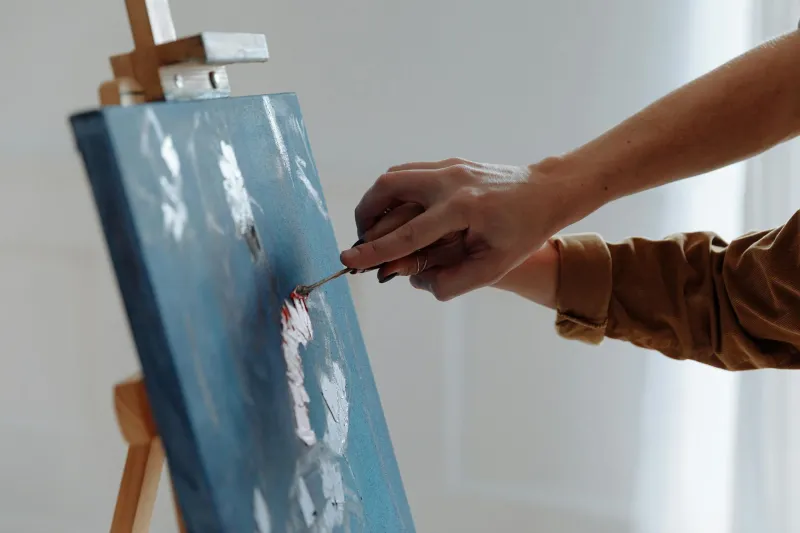
What happened next defied every assumption about how art gets made. Instead of abandoning his brushes, Bramblitt began developing a painting technique that had never been attempted before. He mixed sand and other textures into his paint, creating raised surfaces he could feel with his fingertips. Each color became a different texture – smooth for blues, rough for reds, bumpy for yellows.
He learned to "see" his canvas through touch, running his hands across the surface to understand the composition. His fingers became his eyes, reading the landscape of paint like braille. What started as desperation slowly transformed into innovation.
"I had to completely rewire my brain," Bramblitt later explained. "I went from being a visual artist to being a tactile one, but something unexpected happened – I started painting things I could never see before."
The Memory Vault Opens
Without the distraction of sight, Bramblitt discovered he had access to a vast warehouse of visual memories stored in perfect detail. Landscapes from his childhood in Texas emerged with startling clarity. Colors he hadn't consciously noticed in years came flooding back with emotional intensity that surprised even him.
His paintings began capturing not just how places looked, but how they felt. A sunset over the Hill Country wasn't just orange and red – it was the warmth on his face during evening walks with his father. A thunderstorm approaching across the plains carried the electric tension he remembered from summer afternoons as a boy.
Critics Take Notice
The art world's response was swift and stunning. Galleries that had politely declined his earlier work suddenly clamored for his paintings. Critics who had dismissed his pre-blindness art as "competent but unremarkable" now wrote rapturous reviews about the emotional depth and authenticity of his landscapes.
One New York Times critic wrote: "Bramblitt's paintings possess a quality that's impossible to teach and rare to find – they capture not what a place looks like, but what it means to be human in that place."
The irony wasn't lost on Bramblitt. "I spent years trying to paint what I saw," he reflected. "It wasn't until I couldn't see anymore that I learned to paint what I felt."
Beyond the Canvas
As word of his technique spread, something remarkable happened. Bramblitt began receiving letters from other artists who had lost their vision, begging him to teach them his methods. What started as personal survival became a mission to prove that creativity doesn't depend on any single sense.
He began traveling across the country, teaching workshops for blind and visually impaired artists. His techniques, once born from necessity, became a revolutionary approach to art education. Sighted students began closing their eyes to paint, discovering new depths in their own work.
The Landscape of the Heart
Today, Bramblitt's paintings hang in galleries from New York to Los Angeles, commanding prices that dwarf what his earlier work ever earned. His depictions of American landscapes – from the deserts of New Mexico to the forests of Maine – are celebrated not for their photographic accuracy, but for their emotional truth.
Museum visitors often stand transfixed before his canvases, unaware that the artist never saw the finished work. They're responding to something deeper than visual representation – they're seeing through the eyes of memory and emotion, guided by an artist who learned to paint with his heart when his eyes failed him.
The Deeper Vision
Bramblitt's story challenges our most basic assumptions about disability and limitation. In losing his sight, he didn't lose his ability to create – he discovered abilities he never knew he possessed. His blindness became not a barrier to overcome, but a gateway to a more profound kind of seeing.
"People ask me if I miss being able to see my paintings," Bramblitt says. "But I do see them – just not with my eyes. I see them with my hands, my memories, and my heart. In some ways, I think I see them more clearly now than I ever did before."
His work reminds us that the most important landscapes aren't the ones we observe, but the ones we carry within us – painted not with light and shadow, but with emotion and memory, accessible to anyone willing to close their eyes and truly see.