They Told Her the Operating Room Was No Place for a Woman. She Went and Saved Every Baby Born in America Instead.
They Told Her the Operating Room Was No Place for a Woman. She Went and Saved Every Baby Born in America Instead.
Virginia Apgar did not set out to revolutionize childbirth. She set out to be a surgeon — a perfectly reasonable ambition for someone who had graduated near the top of her class at Columbia University's College of Physicians and Surgeons in 1933. She was sharp, driven, and by every clinical measure, exactly the kind of doctor an operating room needed.
The operating room didn't see it that way.
A Door That Wouldn't Open
The 1930s were not a welcoming era for women in American medicine, and surgery was perhaps its least welcoming corner. When Apgar completed her surgical residency, her department chair — a man she respected and who respected her — sat her down for a conversation she hadn't asked for. The message was delivered kindly, but it was a closed door dressed in professional language: women who tried to build surgical careers were struggling. Patients were skeptical. Colleagues were resistant. The path she wanted, he suggested, wasn't really open to her.
He steered her toward anesthesiology instead.
In 1933, anesthesiology was not the prestigious specialty it is today. It was, bluntly, a backwater — a field that nurses often handled, that physicians considered unglamorous, and that the medical establishment had not yet decided to take seriously. Sending Virginia Apgar there was, whether anyone admitted it or not, a form of professional exile. She was being moved out of the way.
She went anyway. And she decided, with characteristic stubbornness, to build the field from scratch.
Building Something Out of a Consolation Prize
Apgar threw herself into anesthesiology with the energy of someone who had something to prove — because she did. She became one of the first physicians to specialize in the field full-time, helped establish it as a legitimate medical discipline, and eventually became the first woman to head a division at Columbia's medical school. She trained hundreds of anesthesiologists. She elevated the specialty's academic standing almost through sheer force of will.
But the discovery that would define her legacy came later, and it came from a question that nobody else had thought to ask seriously.
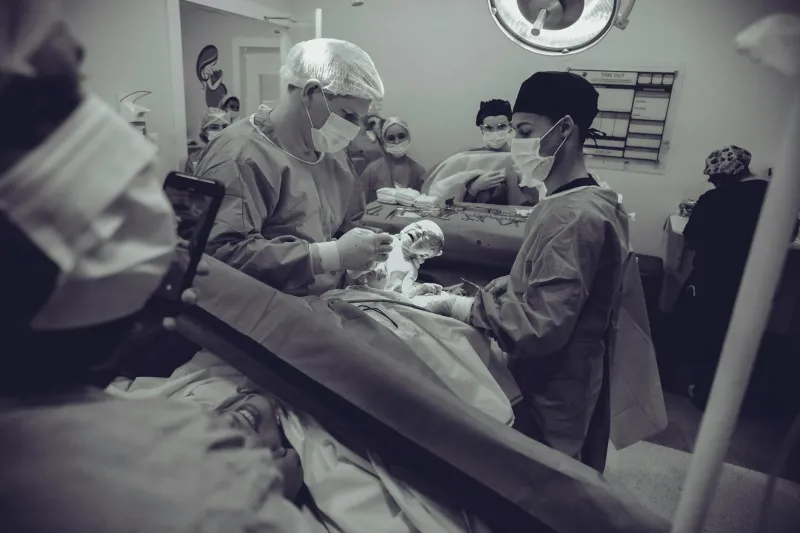
In the delivery room, newborns arrived in wildly different states of health. Some were vigorous and howling. Others were limp, blue, barely breathing. And for decades, the medical response to this spectrum had been largely improvised — a matter of individual judgment, experience, and instinct, with no consistent standard for deciding which babies needed immediate intervention and which were doing just fine.
Apgar, who spent years administering anesthesia during deliveries, watched this chaos and found it unacceptable. In 1952, she grabbed a napkin at breakfast — the story goes — and sketched out a solution.
Sixty Seconds That Changed Everything
The Apgar Score is elegantly simple, which is exactly why it works. One minute after birth, and again at five minutes, a nurse or physician evaluates a newborn across five criteria: heart rate, breathing effort, muscle tone, reflex response, and skin color. Each category gets a score of zero, one, or two. Add them up, and you have a number between zero and ten that tells you, quickly and consistently, how much help this baby needs right now.
It sounds almost too simple. That's the point. In a delivery room, there is no time for lengthy assessments. The Apgar Score gave medical teams a shared language — a fast, reliable way to triage a moment that had previously relied on whoever happened to be in the room and whatever they happened to know.
The results were immediate and dramatic. Babies who needed intervention were identified faster. Outcomes improved. And for the first time, researchers had consistent data on newborn health that they could actually compare and study across hospitals, across years, across the country.
Apgar published her findings in 1953. The medical world, to its credit, recognized the score's value quickly. By the 1960s, it was standard practice across the United States. Today it is used in virtually every delivery room on earth.
The Cruelest Irony
Here is the part of Virginia Apgar's story that ought to make you stop for a moment.
The discrimination that pushed her out of surgery — the casual, institutional assumption that a woman didn't belong at the operating table — was the exact force that pointed her toward the discovery that has saved more lives than most surgeons will touch in a lifetime of operating. Had she been allowed to do what she originally planned, she almost certainly never would have spent those years in the delivery room, watching newborns arrive and wondering why nobody had a better system.
The closed door led somewhere the open door never would have.
That doesn't make the discrimination acceptable. It was wrong, full stop, and Apgar spent her career navigating a professional world that underestimated her at every turn. She never married, worked constantly, and reportedly played a mean bass fiddle — she was, by all accounts, someone who found joy where she could and kept moving regardless.
But there is something worth sitting with in the shape of her story: that the setback meant to diminish her accidentally handed her the tools to do something extraordinary. The people who tried to limit Virginia Apgar's reach ended up expanding it beyond anything they could have imagined.
A Name Every Baby Knows, Even If They Don't Know It
Virginia Apgar died in 1974, at 65, still working, still teaching, still pushing anesthesiology forward. In 1994, the U.S. Postal Service put her face on a stamp. In medical schools, her name is taught as a verb — babies are Apgared within minutes of birth, a linguistic honor usually reserved for the most durable legacies.
Somewhere in America today, a baby is being born. Within sixty seconds, someone in that room will run the Apgar Score — quietly, quickly, automatically, the way you do something that has always been done. They may not know the name behind the checklist. But Virginia Apgar is there anyway, still in the delivery room, still doing the work she wasn't supposed to be doing.