The Divine Chisel: How a Nashville Trash Man Carved His Way to Museum Glory
The Voice in the Yard
In 1931, William Edmondson was doing what he'd done for years—hauling other people's trash through the sweltering streets of Nashville. At 60, the former railroad worker and hospital janitor had settled into the rhythm of manual labor that defined most Black men's lives in Depression-era Tennessee. Then something changed.
Edmondson later described it as a voice—God's voice—telling him to start carving. Not painting, not singing, not any of the artistic pursuits that might seem more accessible to a man with zero formal training. Carving. Stone carving. With tools he'd have to figure out how to use and limestone he'd have to somehow acquire.
Most people would have dismissed such a notion as the product of too much sun and too little sleep. Edmondson picked up a chisel.
The Backyard Revolution
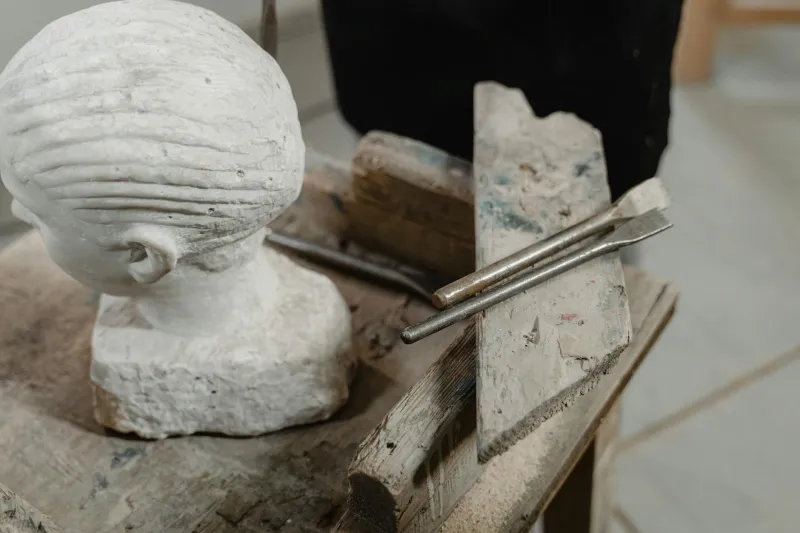
What began in Edmondson's small backyard on 14th Avenue South looked like controlled chaos to his neighbors. Chunks of discarded limestone—some salvaged from construction sites, others bought with his meager wages—began accumulating alongside rudimentary tools. No art books. No instructors. No precedent for what he was attempting.
Edmondson approached stone the way most people approach conversation—naturally, instinctively, without overthinking the mechanics. His hands seemed to know where to strike, how deep to cut, when to step back and let the figure emerge. Angels appeared first, then birds, then human forms that carried an emotional weight that formal training rarely achieves.
The neighbors thought he'd lost his mind. The art world had no idea he existed.
The Photographer's Discovery
Louise Dahl-Wolfe wasn't looking for the next great American artist when she visited Nashville in 1937. The fashion photographer was in town on assignment, but something about the limestone figures scattered around Edmondson's modest home stopped her cold. Here was work that possessed a raw power she'd never encountered in New York galleries or European studios.
Dahl-Wolfe's photographs of Edmondson and his sculptures made their way to the Museum of Modern Art in Manhattan. The response was immediate and unprecedented: MoMA wanted to give this unknown sanitation worker from Nashville the first solo exhibition ever granted to a Black artist in the museum's history.
The art establishment had spent decades debating who deserved recognition, who had paid proper dues, who possessed the right credentials. Then along came a man who'd never set foot in an art school and rendered the entire conversation irrelevant.
Breaking Every Rule
The 1937 MoMA exhibition titled "Sculptures by William Edmondson" shattered assumptions about where artistic genius originates. Here were works created by someone who'd learned his craft not from textbooks but from what he described as divine instruction. Critics struggled to categorize sculptures that possessed both primitive directness and sophisticated emotional depth.
Edmondson's figures—angels with weathered faces, animals caught mid-motion, human forms that seemed to emerge naturally from the stone—spoke a visual language that transcended formal artistic education. His "Angel" pieces carried a spiritual weight that resonated with viewers regardless of their religious beliefs. His animal sculptures captured essential characteristics with an economy of form that would have impressed any trained sculptor.
The New York Times called his work "authentic American folk art." Art critics used words like "powerful" and "moving." But perhaps most significantly, visitors to the exhibition—people with no art background themselves—stood transfixed before sculptures created by a man society had written off as just another laborer.
The Lasting Impact
Edmondson continued carving until his death in 1951, but his influence extended far beyond his own lifetime. His work now resides in the Smithsonian American Art Museum, the Metropolitan Museum of Art, and numerous other prestigious institutions. What began as an old man following mysterious voices in his backyard became a permanent part of America's cultural heritage.
More importantly, Edmondson's story challenged fundamental assumptions about artistic legitimacy. His success suggested that genius doesn't require formal validation—that sometimes the most powerful art emerges from the most unexpected places.
The Divine and the Everyday
Perhaps what makes Edmondson's story so compelling isn't just that he succeeded despite lacking traditional credentials, but that he approached his art with a sense of divine purpose that elevated everyday materials into something transcendent. His limestone came from construction sites and quarries. His tools were basic and often improvised. His studio was a backyard in a working-class neighborhood.
Yet from these humble elements, he created works that continue to move viewers nearly a century later. The garbage collector who claimed God told him to carve proved that artistic vision recognizes no boundaries of class, education, or circumstance.
In a country that often equates worth with credentials and success with formal recognition, William Edmondson carved out a different truth—that sometimes the most profound art comes from the most unlikely hands, guided by forces that can't be taught in any classroom.