The Boy Who Knew Water But Feared Its Depths
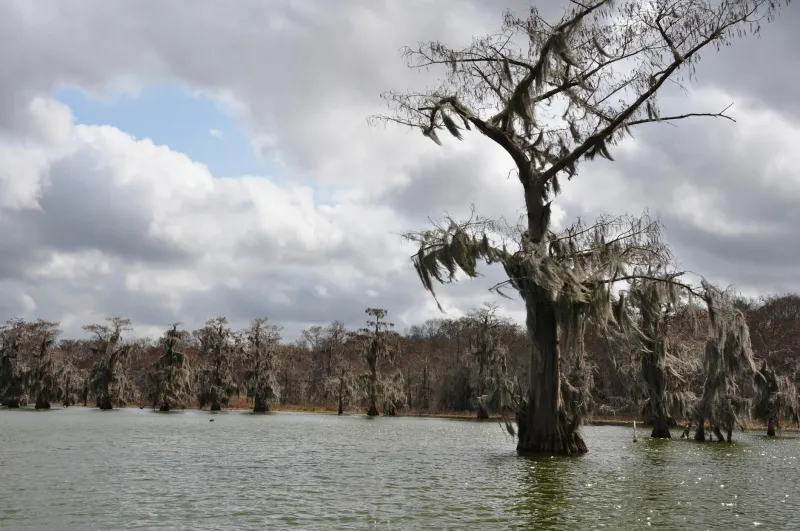
In the humid maze of Louisiana's Atchafalaya Basin, where Spanish moss drapes like curtains over murky channels, a barefoot kid named Eugene Boudreaux spent his childhood learning secrets that would one day reshape American marine science. The irony? He couldn't swim a stroke and was terrified of water deeper than his waist.
Born in 1934 to a Cajun fishing family that scraped by on whatever the bayou provided, Eugene grew up in a world where formal education was a luxury few could afford. His father, Pierre, worked the shallow waters with handmade nets, teaching his son to read the subtle signs that meant the difference between a good catch and going hungry.
"The water, she talks to you," Pierre would say in his thick Cajun accent, pointing to barely perceptible ripples that indicated feeding fish below. "But you got to know her language first."
The Accidental Education
While other kids his age were learning multiplication tables, Eugene was mastering a different kind of mathematics – the complex calculations of tides, moon phases, and seasonal migrations that governed life in the wetlands. He could predict exactly where certain fish would be based on water temperature, salinity levels, and even the direction of the wind.
But there was always that fear. The deep channels that snaked through the swamp terrified him. A near-drowning incident at age seven had left him with a phobia that seemed to contradict everything about his bayou upbringing. While his cousins dove fearlessly into the darker waters, Eugene stayed in the shallows, developing an almost supernatural ability to observe aquatic life from the margins.
This limitation became his greatest strength. Forced to study fish behavior from above the surface, he noticed patterns that escaped even experienced marine biologists who relied on underwater observation. He saw how different species responded to changes in light, how their feeding patterns shifted with weather fronts, and how human activity affected their movements in ways that laboratory studies completely missed.
The Breakthrough That Almost Never Happened
In 1962, at age 28, Eugene was still working as a fishing guide when a group of marine biology graduate students from Tulane University hired him for a research expedition. They were studying the effects of industrial pollution on Gulf Coast ecosystems, and they needed someone who knew the local waters.
The students, armed with expensive equipment and advanced degrees, were struggling to understand why their data didn't match their predictions. Fish populations were behaving in ways their textbooks said were impossible. Spawning grounds appeared to be shifting randomly. Migration patterns seemed completely chaotic.
Eugene watched them for three days, growing increasingly frustrated with their methods. Finally, he couldn't stay quiet any longer.
"Y'all are looking at this all wrong," he said, his Cajun accent thick with exasperation. "You're trying to force the fish to fit your books instead of letting the fish teach you."
The Wisdom of the Outsider
What Eugene explained to those bewildered graduate students would eventually become known as the "Boudreaux Method" – a holistic approach to marine ecosystem observation that considered factors traditional science had largely ignored. He showed them how industrial runoff didn't just affect water chemistry; it altered the behavior of microscopic organisms that formed the base of the entire food chain.
More importantly, he demonstrated how fish populations responded to these changes in ways that could only be detected through long-term, surface-level observation. His fear of deep water had forced him to develop techniques that revealed patterns invisible to conventional underwater research.
Dr. Margaret Thibodaux, one of the graduate students on that expedition, later wrote: "In three days, this fisherman with a seventh-grade education taught us more about marine ecosystems than we'd learned in four years of advanced study. He saw the forest while we were counting individual trees."
From Bayou to Laboratory
Word of Eugene's insights spread through the marine biology community. By 1965, he was consulting for the National Marine Fisheries Service, helping design new approaches to coastal ecosystem management. Universities began inviting him to lecture, though he always insisted on speaking from prepared notes – his formal writing skills remained limited.
The transformation wasn't easy. Eugene struggled with imposter syndrome, constantly feeling out of place among credentialed scientists. He never learned to swim, and his fear of deep water remained. But his unique perspective – shaped by poverty, limited formal education, and physical limitations – proved invaluable in ways no one could have predicted.
His 1971 paper, "Surface Indicators of Subsurface Ecosystem Health," co-authored with Dr. Thibodaux, revolutionized how marine biologists approached field research. The techniques he developed are still used today by researchers studying everything from coral reef health to the effects of climate change on ocean ecosystems.
The Legacy of Staying in the Shallow End
By the time Eugene Boudreaux retired in 1999, he had authored or co-authored over 200 scientific papers, received honorary doctorates from six universities, and fundamentally changed how America manages its coastal resources. The Environmental Protection Agency's current protocols for assessing wetland health are based largely on methods he developed.
But perhaps his greatest contribution was proving that expertise doesn't always come from expected places. The fisherman who was afraid of deep water became America's foremost expert on what lay beneath the surface – not despite his limitations, but because of them.
Today, the Boudreaux Marine Research Station in Louisiana trains a new generation of scientists using methods that blend traditional academic rigor with the kind of intuitive observation that can only be learned by spending a lifetime listening to what the water has to say.
Sometimes the best way to understand the depths is to master the shallows first.